Airbnb vs Long-term Rental Profitability
Is Airbnb more profitable than renting? Short-term rentals (STRs) like Airbnb offer premium nightly rates and higher returns driven by strong guest reviews, while long-term (LTRs) provide steady, predictable income with less management overhead. Understanding financing options for short-term rentals can help maximize your investment's profitability potential.
There's no universal answer. Profitability depends on your property's location, risk tolerance, management approach, and financial goals. What works for a beachfront condo may not work for a suburban single-family home. However, understanding tax deductions for STR businesses can significantly impact your bottom line regardless of property type.
This comparison breaks down the financial frameworks, operational requirements, and risk profiles of STR and LTR models. By examining the numbers and nuances of each approach, you gain insights to determine which rental strategy aligns best with your investment goals and resources.
Profitability Equation for Rental Property
Before discussing the differences between STRs and LTRs, we must establish a common framework for evaluating rental property profitability. The basic formula remains the same, regardless of the rental model:
- Gross Rental Income (GRI) minus Operating Expenses (OpEx)
This equation highlights the two factors that determine profitability:
- Gross Rental Income (GRI): The total rent collected before deducting expenses.
- Operating Expenses (OpEx): All costs for maintaining and running the property, including taxes, insurance, utilities, maintenance, and management fees.
Net Operating Income (NOI) represents your property's true earning power before mortgage payments or debt service. As we compare Airbnb to traditional renting, we will examine how each model affects both sides of this equation, including how strategic design choices can significantly impact your rental rates and overall profitability.
The Airbnb (STR) Model
The short-term rental approach differs from traditional renting. Instead of leasing to a single tenant for months or years, you're running a hospitality business with dozens of "micro-stays" throughout the year. This model creates opportunities and challenges for maximizing rental property profitability, starting with strategic property preparation.
Revenue Potential: Calculating Your Gross Income
STR income is calculated based on two metrics: Average Daily Rate (ADR) and Occupancy Rate. ADR is the average nightly price your property commands, while occupancy rate is the percentage of booked available nights.
If your property has an ADR of $200 and a 75% occupancy rate, your monthly gross income would be:
$200 × (30 days × 75% occupancy) = $200 × 22.5 nights = $4,500 per month
This calculation varies due to seasonality, local events, and your property's market appeal. In high-demand periods, both your ADR and occupancy increase, creating revenue spikes not possible with fixed-rate long-term rentals.
Where Does the Money Go?
Higher revenue potential of STRs comes with increased costs:
- Furnishing & Setup: Fully furnishing an STR can cost $15,000-$50,000+ depending on property size and quality.This includes furniture, décor, kitchenware, linens, smart home technology, and artwork.
- Consumable Supplies: Regular restocking of toiletries, paper products, coffee, cleaning supplies, and other guest amenities.
- Higher Utility Bills: As the owner, you're responsible for all utilities. Guests use them more liberally than long-term tenants.
- Platform Fees: Airbnb, Vrbo, and other booking platforms charge 3-5% of each booking.
- Cleaning & Turnover Costs: Professional cleaning between guests ($100-$300 per turnover depending on property size).
- Higher Management Fees: Professional STR management companies charge 20-30% of gross revenue, compared to 8-12% for LTR management.
- Increased Maintenance & Wear: More people cycling through the property leads to more frequent repairs, replacements, and maintenance.
These expenses can consume 40-60% of your gross revenue. If unmanaged, they can significantly affect profits.
How Data-Driven Design Maximizes Airbnb Investment
While STR expenses are higher, success in this market isn't just about controlling costs. It's about maximizing ADR and occupancy rate. Professional expertise makes a difference.
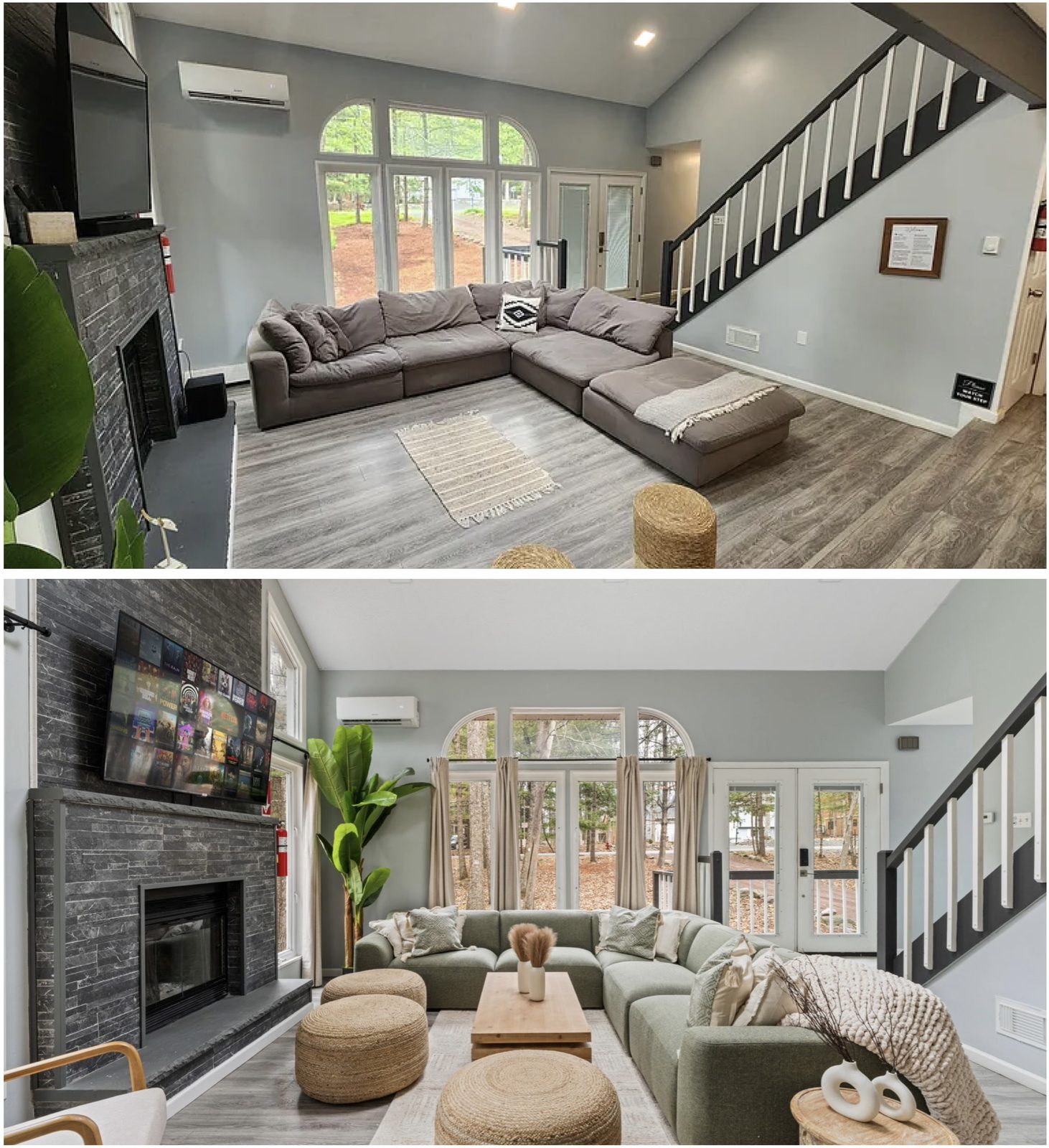
STR Cribs has pioneered a data-driven approach to short-term rental design and renovation. Unlike traditional interior designers focusing on aesthetics, their services analyze market-specific data to create financially performing spaces. By understanding what travelers in a market will pay premium rates for, they create properties that stand out in competitive marketplaces.
This isn't just theory. STR Cribs clients have seen a 64% increase in occupancy rates, 40% higher average daily rates, and earned over $50,000 more in annual revenue compared to similar properties by optimizing for specific market renters' needs. These improvements significantly alter the profitability equation for STR investors.
STR Cribs offers financing up to $100,000 for furnishing for qualified investors to overcome initial setup costs. This makes a professional, revenue-generating setup more attainable without depleting capital reserves.
The Traditional (LTR) Model: Stability and Predictability
Unlike the dynamic STR model, long-term rentals represent a more conventional, passive real estate investment. The revenue ceiling may be lower, but the simplicity and predictability of LTRs remain attractive to many investors.
Revenue Potential: A Reliable Income Stream
LTR income is straightforward. It is determined by a fixed monthly rent in a 12-month lease. If your property rents for $2,200 per month, your annual gross income is $26,400.
While this income lacks the high ceiling of STRs, it offers something many investors value: predictability. Your revenue isn't subject to seasonal fluctuations, travel trends, or pressure to maintain excellent reviews. The rent is contractually guaranteed for the lease term, providing a reliable foundation for financial planning.
The Expense Breakdown: A Clearer Financial Picture
LTRs have a more favorable and predictable expense structure:
- Vacancy: 5-8% of annual rent for tenant turnover periods.
- Property Management: If the property is professionally managed, fees are 8-12% of monthly rent.
- Turnover Costs: Between tenants, painting, cleaning, and minor repairs (often annually) occur.
- Utilities: Most utilities (electricity, gas, internet) are paid by the tenant. Owners usually cover only water/sewer and trash.
- Leasing Fees: A one-time fee to a leasing agent for finding and screening a new tenant, equal to one month's rent.
- Maintenance: Regular maintenance is needed, but wear and tear is less intense than with STRs.
The simplified expense structure means LTRs have operating expense ratios of 30-40% of gross income, compared to 40-60% for STRs.
3 Crucial Factors That Influence the Outcome
While the financial comparison is essential, several non-financial factors can influence which strategy is more advantageous for your situation.
Location, Location, Regulation
The most critical factor in determining whether an STR or LTR will be more profitable is location. An STR is viable only in a market with substantial tourist or business traveler demand. A property in downtown Nashville or near Orlando's theme parks might thrive as an STR, while an identical one in a residential suburb would perform better as an LTR.
The regulatory environment is crucial. Many cities have enacted strict regulations on short-term rentals, including outright bans, severe restrictions, or special licensing. Before pursuing an Airbnb investment, research local zoning laws, HOA regulations, permitting requirements, and STR-specific taxes. Some municipalities have eliminated STRs as an option, making your decision easier.
Your Time and Management Commitment
Self-managing an STR is like running a small hospitality business. It requires consistent attention to guest communication, coordinating cleanings, handling check-ins and check-outs, and addressing emergencies at all hours. This takes 10-15 hours per week.
In contrast, a well-established LTR requires a few hours of monthly management. Professional services can alleviate the time burden for STRs, but the higher fees (20-30% versus 8-12% for LTRs) must be considered in your profitability calculations.
Market Volatility and Risk Profile
STRs are more exposed to market volatility and economic shocks. During COVID-19, many owners faced months of zero income due to halted travel, while most LTRs continued receiving rent. They’re also vulnerable to seasonal fluctuations, new competition, and changing travel patterns.
Your decision should be influenced by your personal risk tolerance. If you prioritize stable cash flow, an LTR is more suitable despite lower returns. If you can handle volatility for higher returns, an STR is better.
Is Airbnb More Profitable Than Renting for You?
The decision depends on aligning the rental strategy with your property, market conditions, and investment objectives.
Choose the Airbnb (STR) Model if:
- Your property is in a popular tourist or business travel area.
- Local regulations support short-term rentals.
- You aim for the highest possible revenue.
- You have the time and energy for active management, or plan to partner with experts like STR Cribs to enhance your operation and maximize returns.
- You have enough capital reserves to manage vacancy periods.
- You're comfortable with fluctuating monthly income.
To choose the Traditional (LTR) Model:
- You prioritize stable cash flow over high revenue.
- You prefer a passive investment approach.
- Your property is in a market with strong demand for long-term housing but limited tourist appeal.
- Local regulations limit short-term rentals.
- You value consistency and are cautious about taking risks.
- You want to reduce ongoing management responsibilities.
Conclusion
Is Airbnb more profitable than renting? It depends on your property's alignment, target market, and investment goals. While STRs offer higher potential returns, they require a strategic, business-oriented approach. LTRs provide reliability and simplicity at the expense of higher profits.
If the high-reward Airbnb investment path aligns with your goals, success lies in execution. Creating a standout property that commands top dollar combines market data with strategic design and operational excellence. Are you ready to see how it can transform your property's potential?